- WhatsApp:+86 17703842005
- Email: support@hmcbn.com

Cubic Boron Nitride (CBN): The Second Hardest Material Revolutionizing Precision Machining
Discover why Cubic Boron Nitride (CBN) outperforms diamond in machining ferrous metals. Explore CBN properties, thermal stability, and its critical role in automotive and aerospace manufacturing.
Introduction: Beyond Diamond
While diamond is renowned as the hardest natural material, Cubic Boron Nitride (CBN) stands as its synthetic counterpart with unique advantages. Often described as having performance “similar to or even surpassing diamond” in specific applications, CBN has become an indispensable tool in modern manufacturing, particularly for processing hard and tough ferrous materials where diamond fails.
1. The Science Behind the Hardness
The “superhard” nature of both CBN and diamond stems from their atomic structure. Both feature a covalent bond angle of 109°28′, which creates an extremely rigid lattice.
Atomic Structure: CBN atoms have a spacing of 1.57 Å, slightly larger than diamond’s 1.5 Å.
Hardness Comparison: This structural similarity results in exceptional hardness. CBN boasts a micro-hardness of 71.54 GPa, significantly higher than Alumina (17.64–27.44 GPa) and Silicon Carbide (25.48–35.28 GPa).
Anisotropy: It is crucial to note that CBN hardness is anisotropic. Knoop hardness tests show:
[100] Direction: ~4,600 kg/mm² (vs. Diamond’s 10,000 kg/mm²)
[110] Direction: ~3,200 kg/mm² (vs. Diamond’s 7,000 kg/mm²)
Despite being slightly softer than diamond, CBN’s true value lies in its thermal and chemical properties.
2. Thermal Superiority: Stability and Conductivity
Unlike diamond, CBN excels where heat is involved.
Unmatched Thermal Stability: CBN can withstand temperatures exceeding 1,200°C, far superior to diamond which oxidizes and graphitizes above 720°C. In a vacuum, CBN remains stable up to 1,550°C before transforming into Hexagonal BN (HBN).
Oxidation Resistance: The boron atoms on the CBN crystal surface saturate valences, eliminating “dangling bonds.” This prevents oxidation at high temperatures, forming a stable oxide layer instead of disintegrating like diamond.
High Thermal Conductivity: With a conductivity of 79.54 W/m·K (compared to Diamond’s 146.5 W/m·K but much higher than carbide’s ~25 W/m·K), CBN efficiently dissipates heat from the cutting zone, reducing diffusion wear.
3. Chemical Inertness: The Ferrous Metal Advantage
This is where CBN truly separates itself from diamond.
Inert to Iron: CBN exhibits extreme chemical inertness toward iron, steel, and nickel-based alloys. It does not react or form carbides.
Diamond’s Weakness: In contrast, diamond readily reacts with iron at high temperatures, causing severe “galling” (build-up of metal on the abrasive) and rendering it ineffective for steel machining. CBN’s inertness makes it the onlychoice for grinding hardened steels and superalloys.
4. Industrial Applications: Grinding vs. Cutting
Due to its properties, CBN is manufactured into two primary tool types:
A. CBN Grinding Wheels (The Most Common Use)
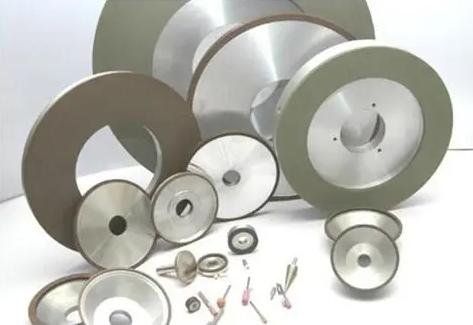
Small-grained CBN bonded into wheels solves the “difficult-to-grind” problem for tough materials.
Performance: Offers a metal removal rate 10 times higher than diamond wheels when grinding ferrous metals.
Materials: Ideal for high-temperature alloys, chilled cast iron, and hardened steel.
Efficiency: Enables high-speed, high-efficiency grinding, drastically reducing auxiliary time for wheel dressing and machine adjustments.
B. CBN Cutting Tools (Indexable Inserts, Drills, Reamers)
For machining workpieces with hardness above HRC 50, CBN tools outperform traditional Alumina Oxide (Corundum) tools.
Applications: Widely used for turning gears, bearings, and turbine blades made from tool steel, stainless steel, and nickel-based alloys.
Benefit: Combines the sharpness of conventional abrasives with the durability of superhard materials.
5. Limitations of Monocrystalline CBN
It is important to acknowledge that single-crystal CBN is not without flaws. Due to its anisotropic nature, it possesses distinct cleavage planes. This makes the grains brittle and prone to fracturing along specific directions during heavy impact, necessitating careful selection of bond systems and operating parameters.
Conclusion
The advent of Cubic Boron Nitride was a monumental contribution to metal cutting. Today, leading universities and research institutions globally are focused on CBN technology. By leveraging its superior thermal stability and chemical inertness, manufacturers achieve unprecedented precision, efficiency, and cost reduction in processing the hardest metals on Earth.
Products
Quick Links
Get In Touch
© 2026 Huamin Tools Rights Reserved.