Aluminum alloys
Share silicon content, cutting operation, target roughness and burr requirements. Material abrasiveness affects grade selection.

Choose a diamond grade and insert geometry for your material, surface finish and production needs. Explore six PCD grades and 18 turning insert families.
Get a Grade RecommendationBrowse Insert ModelsAluminum alloys · Copper & brass · Graphite · Selected composites
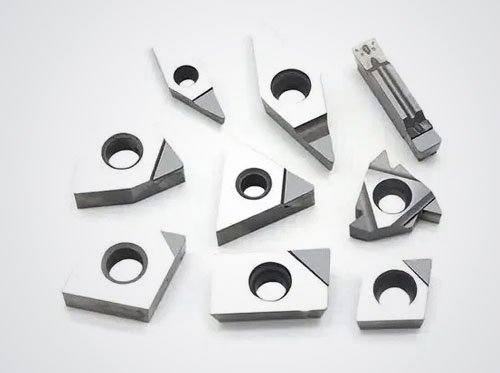
Share silicon content, cutting operation, target roughness and burr requirements. Material abrasiveness affects grade selection.
Identify the alloy and required edge sharpness for precision turning, profiles or finishing.
Specify fillers, reinforcement and interruption level. Abrasive materials require application-specific wear and edge review.
Confirm the actual grade, tip layout and edge preparation for your chosen model. Grade descriptions are not a tool-life guarantee.
Precision finishing of aluminum alloys and composite components.
Sharp edges and fine edge integrity for precision machining.
Ask about MPD85 →Profile and thread turning, non-ferrous components, plastics and wear-resistant parts.
A balance of toughness, edge quality and electrical-discharge processability.
Ask about MPD02 →Fine finishing of aluminum alloys, PMMA and precision non-ferrous contours.
Balanced wear resistance and edge quality with good electrical-discharge processability.
Ask about MPD05 →General turning and roughing of low- to medium-silicon aluminum alloys; piston components.
A general-purpose balance of toughness and abrasive wear resistance.
Ask about MPD10 →High-silicon aluminum, MMC and graphite. Cemented carbide and ceramics require application-specific trials.
Wear-focused grade for abrasive workpieces.
Ask about MPD25 →High-silicon aluminum alloys, MMC and bimetallic components; evaluate each constituent material.
Fine and coarse diamond grains combined for balanced edge integrity and wear resistance.
Ask about MPD302 →Include the alloy designation, heat treatment and abrasive constituents.
Specify roughness, burr limits and dimensional tolerances.
Share speed, feed, depth of cut, coolant and a tool-wear photograph.
PCD inserts use polycrystalline diamond cutting material for selected non-ferrous and abrasive workpieces. Substrate, diamond grade, tip layout and edge preparation affect suitability.
Common applications include aluminum alloys, copper, brass, graphite and selected composites. Confirm the exact material and operation before grade selection.
Conventional PCD is generally not selected for steel or cast iron cutting because of its interaction with ferrous materials at cutting temperatures. Mixed-material parts need a separate application review.
For suitable materials and stable conditions, PCD can support wear resistance, surface consistency and productive machining. Compare actual tool life and cost per part in trials.
Consider material abrasiveness, aluminum silicon content, edge sharpness, roughness, interruption and operation. MPD302 is a mixed-grain grade; no unconfirmed grain ratio or particle-size range is implied.
Send a drawing with substrate dimensions, PCD segment requirements, edge preparation and machining conditions for feasibility review.
The catalog lists reference specifications. Confirm the exact model, segment layout, grade, quantity and drawing for availability and lead time.
Start with your insert code or machining requirement, quantity and email. Material, hardness, silicon content, current parameters, finish target and drawings help technical review.
Open the PCD model directory for family tables or browse the complete PCD catalog. Dimensions and LE values require final drawing confirmation.