
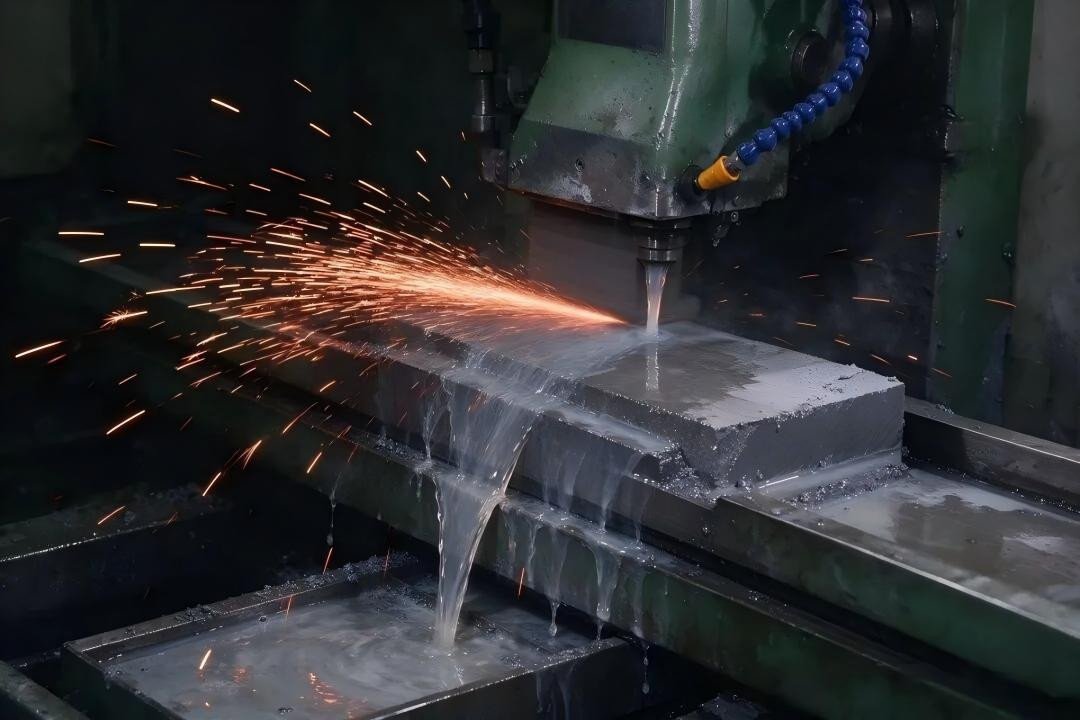
Quick answer: For hard turning with CBN inserts on steels above 45 HRC, oil-based coolant usually delivers better lubricity and insert life; for high-volume roughing with ceramic inserts on cast iron or powdered metals, water-based coolant controls heat more cost-effectively. Choose by material, precision, and batch size—not by habit.
When Does Oil-Based Coolant Win for CBN Insert Machining?
Oil-based coolants reduce friction at the cutting zone. That matters in hard turning of hardened steels from 45 to 65 HRC, where CBN inserts like CNGA and TNGA geometries operate under high mechanical load. Lower friction means less heat generated at the insert edge, slower flank wear, and better surface finish.
Typical workpieces include hardened shafts, gears, and bearing rings. Oil-based coolant also helps when form turning or fine finishing requires tight roughness values below Ra 0.4 µm. In these cases, the lubricating film prevents micro-welding and built-up edge.
However, oil cools poorly, so it is not the first choice for heavy stock removal or long continuous cuts where temperature control dominates.
When Should You Use Water-Based Coolant with Ceramic and CBN Inserts?
Water-based coolants—emulsions, semi-synthetics, or full synthetics—remove heat efficiently. This is critical for roughing cast iron with ceramic inserts, where high cutting speeds generate extreme temperatures. Water-based fluid keeps the insert and workpiece thermally stable, reducing thermal cracking.
For CBN inserts, water-based coolant is often used in high-volume turning of softer hardened steels (45–55 HRC) when cycle time is more important than mirror finish. Modern semi-synthetic fluids now provide adequate lubrication for many medium-duty CBN operations.
Water-based fluid is also the standard for PCD inserts machining aluminum and other non-ferrous materials; oil-based fluid would unnecessarily increase cost and fire risk.
How Do You Match Coolant to Insert Grade and Workpiece Hardness?
Use the table below as a starting point, then validate with a short production test.
| Factor | Oil-Based Coolant | Water-Based Coolant |
|---|---|---|
| Lubricity | High, reduces insert friction | Moderate, depends on additives |
| Cooling capacity | Low, oil retains heat | High, water removes heat quickly |
| Fire hazard | Higher, especially with hot chips | Low |
| Maintenance | Stable but costly waste disposal | Requires concentration and pH monitoring |
| Best for | Hard turning finishing, fine profiles | High-volume roughing, aluminum, cast iron |
| Typical materials | Hardened steel 45–65 HRC, superalloys | Cast iron, powdered metal, non-ferrous |
What Happens If You Choose the Wrong Coolant for CBN or Ceramic Inserts?
Using water-based coolant in a finishing hard turning process that needs oil can cause rapid flank wear, edge chipping, and inconsistent surface finish. You may see CBN insert life drop by half or more, forcing more frequent indexing and increasing cost per part.
Using oil-based coolant in high-speed ceramic roughing of cast iron can overheat the insert, causing thermal cracks and premature failure. Oil mist also creates a fire and health hazard in the shop.
For PCD inserts, oil-based coolant is rarely needed; it adds cost without adding tool life on aluminum, brass, or composites.
How to Test Coolant Performance for Batch Machining
- Select a representative workpiece with typical hardness and stock removal.
- Run the same insert grade (e.g., CBN CNGA120408 or ceramic RNGN45) under both coolant types.
- Record insert wear, surface roughness, cycle time, and scrap rate.
- Calculate cost per part including coolant purchase, waste disposal, and insert cost.
- Run at least one full insert life cycle—not just a few parts—to reach a reliable conclusion.
Many shops run a split-line test: one machine on oil, one on water, same job, then compare data after a week.
Coolant Selection FAQ for CBN, Ceramic, and PCD Insert Machining
Does oil-based coolant always extend CBN insert life?
No. Oil helps in finishing hard turning of steels above 50 HRC, but in roughing or interrupted cuts, the lack of cooling can cause thermal softening of the workpiece and insert edge damage. Always test with your specific insert grade and material.
Can I use water-based coolant for hard turning with CBN inserts?
Yes, for many medium-duty operations on steels from 45 to 55 HRC. Choose a semi-synthetic with high lubricity additives and monitor concentration above 8% to maintain performance.
Should ceramic inserts be run dry or with coolant?
Ceramic inserts are often run dry to avoid thermal shock, but water-based coolant can be used in continuous roughing of cast iron if applied in high volume and high pressure. Never use intermittent coolant; it causes thermal cracks.
What insert grade should I start with for interrupted cuts in hardened steel?
Use a tough CBN grade with a reinforced chamfer, such as a CBN insert with a K-land or honed edge. In ISO terms, look for CBN grades rated for interrupted turning, often with a CNGA or TNGA geometry. Consult the CBN inserts catalog for specific options.
How do I maintain coolant when switching between oil and water?
Never mix oil-based and water-based fluids. Clean the machine, sump, and lines thoroughly before changing. For water-based fluid, check concentration, pH, and bacterial growth weekly; for oil, monitor viscosity and contaminant level.
Related Products and Guides
Send your application data for coolant and insert grade recommendations.